EXERCISE 8.1
Introduction To Trigonometry • 11 Questions
Question 1
Hint available
In ABC, right-angled at B, AB = 24 cm, BC = 7 cm. Determine : (i) sin A, cos A (ii) sin C, cos C
Key Idea
Use the definitions of sine and cosine in a right‑angled triangle: for an acute angle, \(\sin\theta = \frac{\text{opposite side}}{\text{hypotenuse}}\) and \(\cos\theta = \frac{\text{adjacent side}}{\text{hypotenuse}}\). First find the hypotenuse \(AC\) using Pythagoras theorem.
Step-by-Step Solution
1. Find the hypotenuse \(AC\)\
Since \(\triangle ABC\) is right‑angled at \(B\),\
$$AC^2 = AB^2 + BC^2$$\
$$AC^2 = 24^2 + 7^2 = 576 + 49 = 625$$\
$$AC = \sqrt{625} = 25\text{ cm}$$
2. For angle \(A\)\
- Opposite side to \(A\) is \(BC = 7\) cm.\
- Adjacent side to \(A\) is \(AB = 24\) cm.\
$$\sin A = \frac{\text{opposite}}{\text{hypotenuse}} = \frac{BC}{AC} = \frac{7}{25}$$\
$$\cos A = \frac{\text{adjacent}}{\text{hypotenuse}} = \frac{AB}{AC} = \frac{24}{25}$$
3. For angle \(C\)\
- In a right triangle, \(\angle C = 90^{\circ} - \angle A\); therefore the opposite side to \(C\) is \(AB\) and the adjacent side is \(BC\).\
$$\sin C = \frac{AB}{AC} = \frac{24}{25}$$\
$$\cos C = \frac{BC}{AC} = \frac{7}{25}$$
Thus the required trigonometric ratios are obtained.
Since \(\triangle ABC\) is right‑angled at \(B\),\
$$AC^2 = AB^2 + BC^2$$\
$$AC^2 = 24^2 + 7^2 = 576 + 49 = 625$$\
$$AC = \sqrt{625} = 25\text{ cm}$$
2. For angle \(A\)\
- Opposite side to \(A\) is \(BC = 7\) cm.\
- Adjacent side to \(A\) is \(AB = 24\) cm.\
$$\sin A = \frac{\text{opposite}}{\text{hypotenuse}} = \frac{BC}{AC} = \frac{7}{25}$$\
$$\cos A = \frac{\text{adjacent}}{\text{hypotenuse}} = \frac{AB}{AC} = \frac{24}{25}$$
3. For angle \(C\)\
- In a right triangle, \(\angle C = 90^{\circ} - \angle A\); therefore the opposite side to \(C\) is \(AB\) and the adjacent side is \(BC\).\
$$\sin C = \frac{AB}{AC} = \frac{24}{25}$$\
$$\cos C = \frac{BC}{AC} = \frac{7}{25}$$
Thus the required trigonometric ratios are obtained.
Question 2
Hint available
In Fig. 8.13, find tan P – cot R.
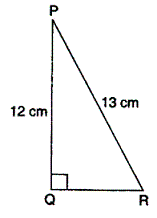
Key Idea
In a right‑angled triangle the two acute angles are complementary (their sum is 90°). For complementary angles θ and (90° − θ), the identity tan θ = cot (90° − θ) holds. Hence tan P and cot R are equal because ∠R = 90° − ∠P.
Step-by-Step Solution
1. From Fig. 8.13 we observe that \(\triangle PQR\) is a right‑angled triangle with the right angle at \(Q\). Therefore the two acute angles satisfy
$$\angle P + \angle R = 90^{\circ}.$$
2. Hence \(\angle R = 90^{\circ} - \angle P\).
3. Using the complementary‑angle identity
$$\cot R = \cot\bigl(90^{\circ} - \angle P\bigr) = \tan \angle P,$$
because \(\cot(90^{\circ} - \theta) = \tan \theta\).
4. Therefore
$$\tan P - \cot R = \tan P - \tan P = 0.$$
5. The required value is \(0\).
$$\angle P + \angle R = 90^{\circ}.$$
2. Hence \(\angle R = 90^{\circ} - \angle P\).
3. Using the complementary‑angle identity
$$\cot R = \cot\bigl(90^{\circ} - \angle P\bigr) = \tan \angle P,$$
because \(\cot(90^{\circ} - \theta) = \tan \theta\).
4. Therefore
$$\tan P - \cot R = \tan P - \tan P = 0.$$
5. The required value is \(0\).
Question 3
Hint available
If sin A = 3 , 4 calculate cos A and tan A.
Key Idea
Use the Pythagorean identity $\sin^2 A + \cos^2 A = 1$ to find $\cos A$, and then use the definition $\tan A = \dfrac{\sin A}{\cos A}$.
Step-by-Step Solution
1. Given $\sin A = \dfrac{3}{4}$.\
2. Apply the identity $\sin^2 A + \cos^2 A = 1$:\
$$\left(\dfrac{3}{4}\right)^2 + \cos^2 A = 1$$\
$$\dfrac{9}{16} + \cos^2 A = 1$$\
$$\cos^2 A = 1 - \dfrac{9}{16} = \dfrac{7}{16}.$$\
3. Since $A$ is an acute angle (implied by $\sin A = \frac34 >0$), $\cos A$ is positive. Hence\
$$\cos A = \sqrt{\dfrac{7}{16}} = \dfrac{\sqrt{7}}{4}.$$\
4. Now compute $\tan A$ using $\tan A = \dfrac{\sin A}{\cos A}$:\
$$\tan A = \dfrac{\dfrac{3}{4}}{\dfrac{\sqrt{7}}{4}} = \dfrac{3}{\sqrt{7}} = \dfrac{3\sqrt{7}}{7}.$$
2. Apply the identity $\sin^2 A + \cos^2 A = 1$:\
$$\left(\dfrac{3}{4}\right)^2 + \cos^2 A = 1$$\
$$\dfrac{9}{16} + \cos^2 A = 1$$\
$$\cos^2 A = 1 - \dfrac{9}{16} = \dfrac{7}{16}.$$\
3. Since $A$ is an acute angle (implied by $\sin A = \frac34 >0$), $\cos A$ is positive. Hence\
$$\cos A = \sqrt{\dfrac{7}{16}} = \dfrac{\sqrt{7}}{4}.$$\
4. Now compute $\tan A$ using $\tan A = \dfrac{\sin A}{\cos A}$:\
$$\tan A = \dfrac{\dfrac{3}{4}}{\dfrac{\sqrt{7}}{4}} = \dfrac{3}{\sqrt{7}} = \dfrac{3\sqrt{7}}{7}.$$
Question 4
Hint available
Given 15 cot A = 8, find sin A and sec A.
Key Idea
Use the definition of cotangent \(\cot A = \frac{\text{adjacent}}{\text{opposite}}\) and the Pythagorean relation \(\sin^2 A + \cos^2 A = 1\). From \(\cot A\) we obtain \(\tan A\), construct a right‑angled triangle, compute the hypotenuse, and then evaluate \(\sin A = \frac{\text{opposite}}{\text{hypotenuse}}\) and \(\sec A = \frac{\text{hypotenuse}}{\text{adjacent}}\).
Step-by-Step Solution
1. Given condition
\[15\cot A = 8 \quad\Rightarrow\quad \cot A = \frac{8}{15}.\]
2. Relation between cot and tan
\[\cot A = \frac{1}{\tan A} \;\Rightarrow\; \tan A = \frac{1}{\cot A}=\frac{15}{8}.\]
3. Form a right‑angled triangle
Let the side opposite \(A\) be \(15\) units and the side adjacent to \(A\) be \(8\) units (consistent with \(\tan A = \frac{\text{opposite}}{\text{adjacent}} = \frac{15}{8}\)).
4. Find the hypotenuse using Pythagoras theorem:
\[\text{hypotenuse} = \sqrt{8^{2}+15^{2}} = \sqrt{64+225}=\sqrt{289}=17.\]
5. Compute \(\sin A\)
\[\sin A = \frac{\text{opposite}}{\text{hypotenuse}} = \frac{15}{17}.\]
6. Compute \(\sec A\)
\[\sec A = \frac{\text{hypotenuse}}{\text{adjacent}} = \frac{17}{8}.\]
7. Answer
\[\sin A = \frac{15}{17}, \qquad \sec A = \frac{17}{8}.\]
\[15\cot A = 8 \quad\Rightarrow\quad \cot A = \frac{8}{15}.\]
2. Relation between cot and tan
\[\cot A = \frac{1}{\tan A} \;\Rightarrow\; \tan A = \frac{1}{\cot A}=\frac{15}{8}.\]
3. Form a right‑angled triangle
Let the side opposite \(A\) be \(15\) units and the side adjacent to \(A\) be \(8\) units (consistent with \(\tan A = \frac{\text{opposite}}{\text{adjacent}} = \frac{15}{8}\)).
4. Find the hypotenuse using Pythagoras theorem:
\[\text{hypotenuse} = \sqrt{8^{2}+15^{2}} = \sqrt{64+225}=\sqrt{289}=17.\]
5. Compute \(\sin A\)
\[\sin A = \frac{\text{opposite}}{\text{hypotenuse}} = \frac{15}{17}.\]
6. Compute \(\sec A\)
\[\sec A = \frac{\text{hypotenuse}}{\text{adjacent}} = \frac{17}{8}.\]
7. Answer
\[\sin A = \frac{15}{17}, \qquad \sec A = \frac{17}{8}.\]
Question 5
Hint available
Given sec = 13 , 12 calculate all other trigonometric ratios.
Key Idea
Use the reciprocal identities (\(\sec\theta = \dfrac{1}{\cos\theta}\), \(\csc\theta = \dfrac{1}{\sin\theta}\), \(\cot\theta = \dfrac{1}{\tan\theta}\)) and the fundamental Pythagorean identity \(\sin^{2}\theta + \cos^{2}\theta = 1\) to find the remaining ratios.
Step-by-Step Solution
1. Find \(\cos\theta\) using the reciprocal identity of secant:
$$\cos\theta = \frac{1}{\sec\theta} = \frac{1}{\dfrac{13}{12}} = \frac{12}{13}.$$
2. Find \(\sin\theta\) from the Pythagorean identity:
$$\sin^{2}\theta = 1 - \cos^{2}\theta = 1 - \left(\frac{12}{13}\right)^{2} = 1 - \frac{144}{169} = \frac{25}{169}.$$
Hence,
$$\sin\theta = \sqrt{\frac{25}{169}} = \frac{5}{13}$$ (taking the positive value as \(\theta\) is an acute angle in the context of NCERT exercises).
3. Find \(\tan\theta\) using the definition \(\tan\theta = \dfrac{\sin\theta}{\cos\theta}\):
$$\tan\theta = \frac{\dfrac{5}{13}}{\dfrac{12}{13}} = \frac{5}{12}.$$
4. Find \(\csc\theta\) (reciprocal of sine):
$$\csc\theta = \frac{1}{\sin\theta} = \frac{1}{\dfrac{5}{13}} = \frac{13}{5}.$$
5. Find \(\cot\theta\) (reciprocal of tangent):
$$\cot\theta = \frac{1}{\tan\theta} = \frac{1}{\dfrac{5}{12}} = \frac{12}{5}.$$
6. Verify the given secant (reciprocal of cosine):
$$\sec\theta = \frac{1}{\cos\theta} = \frac{1}{\dfrac{12}{13}} = \frac{13}{12},$$
which matches the given value, confirming the calculations.
$$\cos\theta = \frac{1}{\sec\theta} = \frac{1}{\dfrac{13}{12}} = \frac{12}{13}.$$
2. Find \(\sin\theta\) from the Pythagorean identity:
$$\sin^{2}\theta = 1 - \cos^{2}\theta = 1 - \left(\frac{12}{13}\right)^{2} = 1 - \frac{144}{169} = \frac{25}{169}.$$
Hence,
$$\sin\theta = \sqrt{\frac{25}{169}} = \frac{5}{13}$$ (taking the positive value as \(\theta\) is an acute angle in the context of NCERT exercises).
3. Find \(\tan\theta\) using the definition \(\tan\theta = \dfrac{\sin\theta}{\cos\theta}\):
$$\tan\theta = \frac{\dfrac{5}{13}}{\dfrac{12}{13}} = \frac{5}{12}.$$
4. Find \(\csc\theta\) (reciprocal of sine):
$$\csc\theta = \frac{1}{\sin\theta} = \frac{1}{\dfrac{5}{13}} = \frac{13}{5}.$$
5. Find \(\cot\theta\) (reciprocal of tangent):
$$\cot\theta = \frac{1}{\tan\theta} = \frac{1}{\dfrac{5}{12}} = \frac{12}{5}.$$
6. Verify the given secant (reciprocal of cosine):
$$\sec\theta = \frac{1}{\cos\theta} = \frac{1}{\dfrac{12}{13}} = \frac{13}{12},$$
which matches the given value, confirming the calculations.
Question 6
Hint available
If A and B are acute angles such that cos A = cos B, then show that A = B.
Key Idea
In the interval of acute angles (0° < θ < 90°), the cosine function is strictly decreasing, i.e., it is one‑to‑one. Hence equal cosine values imply equal angles. Alternatively, using the identity \(\cos A-\cos B = -2\sin\frac{A+B}{2}\sin\frac{A-B}{2}\) and the fact that \(\sin\frac{A+B}{2}
eq0\) for acute angles leads to \(\sin\frac{A-B}{2}=0\) and thus \(A=B\).
eq0\) for acute angles leads to \(\sin\frac{A-B}{2}=0\) and thus \(A=B\).
Step-by-Step Solution
1. Given \(\cos A = \cos B\) with \(A,B\) acute (0° < A,B < 90°).\
2. Subtract the two sides: \(\cos A - \cos B = 0\).\
3. Use the trigonometric identity\
$$\cos A - \cos B = -2\sin\frac{A+B}{2}\,\sin\frac{A-B}{2}.$$\
Hence\
$$-2\sin\frac{A+B}{2}\,\sin\frac{A-B}{2}=0.$$\
4. For acute angles, \(0°0\).\
5. Since the product is zero and \(\sin\frac{A+B}{2}
eq0\), we must have\
$$\sin\frac{A-B}{2}=0.$$\
6. The sine of an angle is zero only when the angle is an integer multiple of \(180°\). Because \(\frac{A-B}{2}\) lies between \(-45°\) and \(45°\) (as A and B are acute), the only possible multiple is 0°; thus\
$$\frac{A-B}{2}=0° \quad\Rightarrow\quad A-B=0°.$$\
7. Hence \(A = B\).\
8. Therefore, if \(\cos A = \cos B\) for acute angles, the angles must be equal.
Answer: \(\displaystyle \angle A = \angle B\).
2. Subtract the two sides: \(\cos A - \cos B = 0\).\
3. Use the trigonometric identity\
$$\cos A - \cos B = -2\sin\frac{A+B}{2}\,\sin\frac{A-B}{2}.$$\
Hence\
$$-2\sin\frac{A+B}{2}\,\sin\frac{A-B}{2}=0.$$\
4. For acute angles, \(0°
5. Since the product is zero and \(\sin\frac{A+B}{2}
eq0\), we must have\
$$\sin\frac{A-B}{2}=0.$$\
6. The sine of an angle is zero only when the angle is an integer multiple of \(180°\). Because \(\frac{A-B}{2}\) lies between \(-45°\) and \(45°\) (as A and B are acute), the only possible multiple is 0°; thus\
$$\frac{A-B}{2}=0° \quad\Rightarrow\quad A-B=0°.$$\
7. Hence \(A = B\).\
8. Therefore, if \(\cos A = \cos B\) for acute angles, the angles must be equal.
Answer: \(\displaystyle \angle A = \angle B\).
Question 7
Hint available
If cot = 7 , 8 evaluate : (i) (1 sin )(1 sin ) , (1 cos )(1 cos ) (ii) cot2
Key Idea
Use the definition \(\cot\theta = \dfrac{\cos\theta}{\sin\theta}\) to find \(\sin\theta\) and \(\cos\theta\) by constructing a right‑angled triangle with sides proportional to the numerator and denominator of cot. Then substitute these values in the required expressions.
Step-by-Step Solution
1. Given \(\cot\theta = \dfrac{7}{8}\).
\[\cot\theta = \frac{\cos\theta}{\sin\theta}=\frac{7}{8}\]
Hence \(\tan\theta = \dfrac{1}{\cot\theta}=\dfrac{8}{7}\).
2. Construct a right‑angled triangle where the side opposite \(\theta\) is 8 and the side adjacent to \(\theta\) is 7.
The hypotenuse \(h\) is
\[h = \sqrt{7^{2}+8^{2}} = \sqrt{49+64}=\sqrt{113}.\]
3. Find \(\sin\theta\) and \(\cos\theta\)
\[\sin\theta = \frac{\text{opposite}}{\text{hypotenuse}} = \frac{8}{\sqrt{113}},\qquad \cos\theta = \frac{\text{adjacent}}{\text{hypotenuse}} = \frac{7}{\sqrt{113}}.\]
4. Evaluate part (i)
\[\text{Expression} = \frac{(1+\sin\theta)(1+\cos\theta)}{\sin\theta-\cos\theta}.
\]
- Numerator:
\[(1+\sin\theta)(1+\cos\theta) = \left(1+\frac{8}{\sqrt{113}}\right)\left(1+\frac{7}{\sqrt{113}}\right)\]
\[= 1 + \frac{8+7}{\sqrt{113}} + \frac{8\times7}{113}
= 1 + \frac{15}{\sqrt{113}} + \frac{56}{113}.\]
- Denominator:
\[\sin\theta-\cos\theta = \frac{8-7}{\sqrt{113}} = \frac{1}{\sqrt{113}}.\]
- Division:
\[\frac{1 + \frac{15}{\sqrt{113}} + \frac{56}{113}}{\frac{1}{\sqrt{113}}}
= \left(1 + \frac{15}{\sqrt{113}} + \frac{56}{113}\right)\sqrt{113}
= \sqrt{113} + 15 + \frac{56}{\sqrt{113}}.
\]
- Combining the terms over a common denominator \(\sqrt{113}\):
\[\frac{\sqrt{113}\times\sqrt{113} + 15\sqrt{113} + 56}{\sqrt{113}}
= \frac{113 + 15\sqrt{113} + 56}{\sqrt{113}}
= \frac{169 + 15\sqrt{113}}{\sqrt{113}}.
\]
Hence
\[\boxed{\frac{(1+\sin\theta)(1+\cos\theta)}{\sin\theta-\cos\theta}=\sqrt{113}+15+\frac{56}{\sqrt{113}} = \frac{169+15\sqrt{113}}{\sqrt{113}}}.\]
5. Evaluate part (ii)
\[\cot^{2}\theta = \left(\frac{7}{8}\right)^{2}=\frac{49}{64}.\]
Hence
\[\boxed{\cot^{2}\theta = \frac{49}{64}}.\]
Final Answers
- (i) \(\displaystyle \frac{169+15\sqrt{113}}{\sqrt{113}}\) (or equivalently \(\sqrt{113}+15+\frac{56}{\sqrt{113}}\)).
- (ii) \(\displaystyle \frac{49}{64}\).
\[\cot\theta = \frac{\cos\theta}{\sin\theta}=\frac{7}{8}\]
Hence \(\tan\theta = \dfrac{1}{\cot\theta}=\dfrac{8}{7}\).
2. Construct a right‑angled triangle where the side opposite \(\theta\) is 8 and the side adjacent to \(\theta\) is 7.
The hypotenuse \(h\) is
\[h = \sqrt{7^{2}+8^{2}} = \sqrt{49+64}=\sqrt{113}.\]
3. Find \(\sin\theta\) and \(\cos\theta\)
\[\sin\theta = \frac{\text{opposite}}{\text{hypotenuse}} = \frac{8}{\sqrt{113}},\qquad \cos\theta = \frac{\text{adjacent}}{\text{hypotenuse}} = \frac{7}{\sqrt{113}}.\]
4. Evaluate part (i)
\[\text{Expression} = \frac{(1+\sin\theta)(1+\cos\theta)}{\sin\theta-\cos\theta}.
\]
- Numerator:
\[(1+\sin\theta)(1+\cos\theta) = \left(1+\frac{8}{\sqrt{113}}\right)\left(1+\frac{7}{\sqrt{113}}\right)\]
\[= 1 + \frac{8+7}{\sqrt{113}} + \frac{8\times7}{113}
= 1 + \frac{15}{\sqrt{113}} + \frac{56}{113}.\]
- Denominator:
\[\sin\theta-\cos\theta = \frac{8-7}{\sqrt{113}} = \frac{1}{\sqrt{113}}.\]
- Division:
\[\frac{1 + \frac{15}{\sqrt{113}} + \frac{56}{113}}{\frac{1}{\sqrt{113}}}
= \left(1 + \frac{15}{\sqrt{113}} + \frac{56}{113}\right)\sqrt{113}
= \sqrt{113} + 15 + \frac{56}{\sqrt{113}}.
\]
- Combining the terms over a common denominator \(\sqrt{113}\):
\[\frac{\sqrt{113}\times\sqrt{113} + 15\sqrt{113} + 56}{\sqrt{113}}
= \frac{113 + 15\sqrt{113} + 56}{\sqrt{113}}
= \frac{169 + 15\sqrt{113}}{\sqrt{113}}.
\]
Hence
\[\boxed{\frac{(1+\sin\theta)(1+\cos\theta)}{\sin\theta-\cos\theta}=\sqrt{113}+15+\frac{56}{\sqrt{113}} = \frac{169+15\sqrt{113}}{\sqrt{113}}}.\]
5. Evaluate part (ii)
\[\cot^{2}\theta = \left(\frac{7}{8}\right)^{2}=\frac{49}{64}.\]
Hence
\[\boxed{\cot^{2}\theta = \frac{49}{64}}.\]
Final Answers
- (i) \(\displaystyle \frac{169+15\sqrt{113}}{\sqrt{113}}\) (or equivalently \(\sqrt{113}+15+\frac{56}{\sqrt{113}}\)).
- (ii) \(\displaystyle \frac{49}{64}\).
Question 8
Hint available
If 3 cot A = 4, check whether 2 2 1 tan A 1 + tan A = cos2 A – sin2A or not.
Key Idea
Use the given relation to find \(\tan A\). Then evaluate the left‑hand side (LHS) using the identity \(\frac{2\tan A}{1+\tan^2 A}=\sin 2A\) and evaluate the right‑hand side (RHS) using the fundamental definitions \(\sin A=\frac{\text{opposite}}{\text{hypotenuse}},\; \cos A=\frac{\text{adjacent}}{\text{hypotenuse}}\) and the double‑angle formulas \(\sin 2A=2\sin A\cos A\) and \(\cos 2A=\cos^2 A-\sin^2 A\). Compare the two results.
Step-by-Step Solution
1. Given condition
\[3\cot A = 4 \quad\Rightarrow\quad \cot A = \frac{4}{3}.
\]
Since \(\cot A = \frac{1}{\tan A}\), we have
\[\tan A = \frac{3}{4}.
\]
2. Compute the left‑hand side (LHS)
\[\text{LHS}=\frac{2\tan A}{1+\tan^{2} A}.
\]
Substituting \(\tan A = \frac{3}{4}\):
\[\tan^{2} A = \left(\frac{3}{4}\right)^{2}=\frac{9}{16},\qquad
1+\tan^{2} A = 1+\frac{9}{16}=\frac{25}{16}.
\]
Numerator:
\[2\tan A = 2\times\frac{3}{4}=\frac{3}{2}.
\]
Hence
\[\text{LHS}=\frac{\frac{3}{2}}{\frac{25}{16}}=\frac{3}{2}\times\frac{16}{25}=\frac{48}{50}=\frac{24}{25}.
\]
3. Find \(\sin A\) and \(\cos A\)
From \(\tan A = \frac{3}{4}\), consider a right‑angled triangle with opposite side = 3, adjacent side = 4. Then the hypotenuse is \(\sqrt{3^{2}+4^{2}}=5\).
Therefore
\[\sin A = \frac{3}{5},\qquad \cos A = \frac{4}{5}.
\]
4. Compute the right‑hand side (RHS)
Using double‑angle formulas:
\[\sin 2A = 2\sin A\cos A = 2\times\frac{3}{5}\times\frac{4}{5}=\frac{24}{25},\]
\[\cos 2A = \cos^{2} A-\sin^{2} A = \left(\frac{4}{5}\right)^{2}-\left(\frac{3}{5}\right)^{2}=\frac{16}{25}-\frac{9}{25}=\frac{7}{25}.
\]
Hence
\[\text{RHS}=\cos 2A-\sin 2A = \frac{7}{25}-\frac{24}{25}= -\frac{17}{25}.
\]
5. Comparison
\[\text{LHS}=\frac{24}{25},\qquad \text{RHS}= -\frac{17}{25}.
\]
Since \(\frac{24}{25}
eq -\frac{17}{25}\), the given equality does not hold.
6. Conclusion
The statement \(\displaystyle \frac{2\tan A}{1+\tan^{2} A}=\cos 2A-\sin 2A\) is false for the angle satisfying \(3\cot A =4\).
\[3\cot A = 4 \quad\Rightarrow\quad \cot A = \frac{4}{3}.
\]
Since \(\cot A = \frac{1}{\tan A}\), we have
\[\tan A = \frac{3}{4}.
\]
2. Compute the left‑hand side (LHS)
\[\text{LHS}=\frac{2\tan A}{1+\tan^{2} A}.
\]
Substituting \(\tan A = \frac{3}{4}\):
\[\tan^{2} A = \left(\frac{3}{4}\right)^{2}=\frac{9}{16},\qquad
1+\tan^{2} A = 1+\frac{9}{16}=\frac{25}{16}.
\]
Numerator:
\[2\tan A = 2\times\frac{3}{4}=\frac{3}{2}.
\]
Hence
\[\text{LHS}=\frac{\frac{3}{2}}{\frac{25}{16}}=\frac{3}{2}\times\frac{16}{25}=\frac{48}{50}=\frac{24}{25}.
\]
3. Find \(\sin A\) and \(\cos A\)
From \(\tan A = \frac{3}{4}\), consider a right‑angled triangle with opposite side = 3, adjacent side = 4. Then the hypotenuse is \(\sqrt{3^{2}+4^{2}}=5\).
Therefore
\[\sin A = \frac{3}{5},\qquad \cos A = \frac{4}{5}.
\]
4. Compute the right‑hand side (RHS)
Using double‑angle formulas:
\[\sin 2A = 2\sin A\cos A = 2\times\frac{3}{5}\times\frac{4}{5}=\frac{24}{25},\]
\[\cos 2A = \cos^{2} A-\sin^{2} A = \left(\frac{4}{5}\right)^{2}-\left(\frac{3}{5}\right)^{2}=\frac{16}{25}-\frac{9}{25}=\frac{7}{25}.
\]
Hence
\[\text{RHS}=\cos 2A-\sin 2A = \frac{7}{25}-\frac{24}{25}= -\frac{17}{25}.
\]
5. Comparison
\[\text{LHS}=\frac{24}{25},\qquad \text{RHS}= -\frac{17}{25}.
\]
Since \(\frac{24}{25}
eq -\frac{17}{25}\), the given equality does not hold.
6. Conclusion
The statement \(\displaystyle \frac{2\tan A}{1+\tan^{2} A}=\cos 2A-\sin 2A\) is false for the angle satisfying \(3\cot A =4\).
Question 9
Hint available
In triangle ABC, right-angled at B, if tan A = 1 , 3 find the value of: (i) sin A cos C + cos A sin C (ii) cos A cos C – sin A sin C
Key Idea
Use the complementary relationship in a right‑angled triangle (A + C = 90°) and the sum‑to‑product identities: \(\sin(A+C)=\sin A\cos C+\cos A\sin C\) and \(\cos(A+C)=\cos A\cos C-\sin A\sin C\). The given \(\tan A\) helps to compute \(\sin A\) and \(\cos A\) if required.
Step-by-Step Solution
1. Since \(\triangle ABC\) is right‑angled at \(B\), we have
$$A + C = 90^{\circ}.$$
2. From the given \(\tan A = \frac{1}{3}\), consider a right‑angled triangle with opposite side = 1 and adjacent side = 3.
\[\text{hypotenuse}=\sqrt{1^{2}+3^{2}}=\sqrt{10}.\]
Hence
$$\sin A = \frac{1}{\sqrt{10}}, \qquad \cos A = \frac{3}{\sqrt{10}}.$$
3. Because \(C = 90^{\circ} - A\), the complementary‑angle relations give
$$\sin C = \cos A = \frac{3}{\sqrt{10}}, \qquad \cos C = \sin A = \frac{1}{\sqrt{10}}.$$
4. Part (i)
\[\sin A\cos C + \cos A\sin C = \sin A\cdot\sin A + \cos A\cdot\cos A
= \left(\frac{1}{\sqrt{10}}\right)^{2}+\left(\frac{3}{\sqrt{10}}\right)^{2}
= \frac{1}{10}+\frac{9}{10}=1.\]
Alternatively, using the sum formula:
$$\sin(A+C)=\sin 90^{\circ}=1.$$
5. Part (ii)
\[\cos A\cos C - \sin A\sin C = \cos A\cdot\sin A - \sin A\cdot\cos A
= \frac{3}{\sqrt{10}}\cdot\frac{1}{\sqrt{10}}-\frac{1}{\sqrt{10}}\cdot\frac{3}{\sqrt{10}}=0.\]
Or, using the cosine sum formula:
$$\cos(A+C)=\cos 90^{\circ}=0.$$
6. Hence the required values are:
\[\text{(i)}\;=1, \qquad \text{(ii)}\;=0.\]
$$A + C = 90^{\circ}.$$
2. From the given \(\tan A = \frac{1}{3}\), consider a right‑angled triangle with opposite side = 1 and adjacent side = 3.
\[\text{hypotenuse}=\sqrt{1^{2}+3^{2}}=\sqrt{10}.\]
Hence
$$\sin A = \frac{1}{\sqrt{10}}, \qquad \cos A = \frac{3}{\sqrt{10}}.$$
3. Because \(C = 90^{\circ} - A\), the complementary‑angle relations give
$$\sin C = \cos A = \frac{3}{\sqrt{10}}, \qquad \cos C = \sin A = \frac{1}{\sqrt{10}}.$$
4. Part (i)
\[\sin A\cos C + \cos A\sin C = \sin A\cdot\sin A + \cos A\cdot\cos A
= \left(\frac{1}{\sqrt{10}}\right)^{2}+\left(\frac{3}{\sqrt{10}}\right)^{2}
= \frac{1}{10}+\frac{9}{10}=1.\]
Alternatively, using the sum formula:
$$\sin(A+C)=\sin 90^{\circ}=1.$$
5. Part (ii)
\[\cos A\cos C - \sin A\sin C = \cos A\cdot\sin A - \sin A\cdot\cos A
= \frac{3}{\sqrt{10}}\cdot\frac{1}{\sqrt{10}}-\frac{1}{\sqrt{10}}\cdot\frac{3}{\sqrt{10}}=0.\]
Or, using the cosine sum formula:
$$\cos(A+C)=\cos 90^{\circ}=0.$$
6. Hence the required values are:
\[\text{(i)}\;=1, \qquad \text{(ii)}\;=0.\]
Question 10
Hint available
In PQR, right-angled at Q, PR + QR = 25 cm and PQ = 5 cm. Determine the values of sin P, cos P and tan P.
Key Idea
Use Pythagoras theorem to find the unknown side of the right‑angled triangle and then apply the definitions of sine, cosine and tangent for the acute angle P (opposite side / hypotenuse, adjacent side / hypotenuse, opposite side / adjacent side).
Step-by-Step Solution
1. Identify the sides:\
- Right angle at Q ⇒ PR is the hypotenuse.\
- Given: \(PQ = 5\) cm, \(PR + QR = 25\) cm.\
- Let \(QR = x\) cm, then \(PR = 25 - x\) cm.\
2. Apply Pythagoras theorem:\
\[PQ^{2} + QR^{2} = PR^{2}\]\
Substituting the known values:\
\[5^{2} + x^{2} = (25 - x)^{2}\]\
\[25 + x^{2} = 625 - 50x + x^{2}\]\
Cancel \(x^{2}\) from both sides and solve for \(x\):\
\[25 = 625 - 50x\]\
\[50x = 600\]\
\[x = 12\]\
Hence, \(QR = 12\) cm and \(PR = 25 - 12 = 13\) cm.\
3. Compute the trigonometric ratios for angle \(P\):\
- Opposite side to \(P\) = \(QR = 12\) cm\
- Adjacent side to \(P\) = \(PQ = 5\) cm\
- Hypotenuse = \(PR = 13\) cm\
\[\sin P = \frac{\text{opposite}}{\text{hypotenuse}} = \frac{12}{13}\]\
\[\cos P = \frac{\text{adjacent}}{\text{hypotenuse}} = \frac{5}{13}\]\
\[\tan P = \frac{\text{opposite}}{\text{adjacent}} = \frac{12}{5} = 2.4\]\
4. State the answers:\
\(\sin P = \frac{12}{13},\; \cos P = \frac{5}{13},\; \tan P = \frac{12}{5} = 2.4\).
- Right angle at Q ⇒ PR is the hypotenuse.\
- Given: \(PQ = 5\) cm, \(PR + QR = 25\) cm.\
- Let \(QR = x\) cm, then \(PR = 25 - x\) cm.\
2. Apply Pythagoras theorem:\
\[PQ^{2} + QR^{2} = PR^{2}\]\
Substituting the known values:\
\[5^{2} + x^{2} = (25 - x)^{2}\]\
\[25 + x^{2} = 625 - 50x + x^{2}\]\
Cancel \(x^{2}\) from both sides and solve for \(x\):\
\[25 = 625 - 50x\]\
\[50x = 600\]\
\[x = 12\]\
Hence, \(QR = 12\) cm and \(PR = 25 - 12 = 13\) cm.\
3. Compute the trigonometric ratios for angle \(P\):\
- Opposite side to \(P\) = \(QR = 12\) cm\
- Adjacent side to \(P\) = \(PQ = 5\) cm\
- Hypotenuse = \(PR = 13\) cm\
\[\sin P = \frac{\text{opposite}}{\text{hypotenuse}} = \frac{12}{13}\]\
\[\cos P = \frac{\text{adjacent}}{\text{hypotenuse}} = \frac{5}{13}\]\
\[\tan P = \frac{\text{opposite}}{\text{adjacent}} = \frac{12}{5} = 2.4\]\
4. State the answers:\
\(\sin P = \frac{12}{13},\; \cos P = \frac{5}{13},\; \tan P = \frac{12}{5} = 2.4\).
Question 11
Hint available
State whether the following are true or false. Justify your answer. (i) The value of tan A is always less than 1. (ii) sec A = 12 5 for some value of angle A. (iii) cos A is the abbreviation used for the cosecant of angle A. (iv) cot A is the product of cot and A. (v) sin = 4 3 for some angle .
Key Idea
Use the definitions of the six trigonometric ratios for an acute angle $\theta$ in a right‑angled triangle: \[\sin\theta=\frac{\text{opposite}}{\text{hypotenuse}},\quad \cos\theta=\frac{\text{adjacent}}{\text{hypotenuse}},\quad \tan\theta=\frac{\text{opposite}}{\text{adjacent}};\] \[\sec\theta=\frac{1}{\cos\theta},\quad \csc\theta=\frac{1}{\sin\theta},\quad \cot\theta=\frac{1}{\tan\theta}.\] The values of \(\sin\theta\) and \(\cos\theta\) lie in $[0,1]$ for $0^\circ\le\theta\le90^\circ$, hence \(\tan\theta$ and $\cot\theta$ can be less than, equal to, or greater than 1. The reciprocal functions $\sec\theta$ and $\csc\theta$ satisfy $|\sec\theta|\ge1$ and $|\csc\theta|\ge1$. Also note the standard abbreviations: "cos" stands for cosine, not cosecant.
Step-by-Step Solution
1. Statement (i): "The value of $\tan A$ is always less than 1."
- From the definition $\tan A = \frac{\text{opposite}}{\text{adjacent}}$, the ratio can be any non‑negative real number depending on the relative lengths of the sides. For example, if the opposite side is longer than the adjacent side, $\tan A > 1$ (e.g., $A=60^\circ$, $\tan 60^\circ = \sqrt{3} \approx 1.73$).
- Conclusion: False.
2. Statement (ii): "$\sec A = \frac{12}{5}$ for some value of angle $A$."
- $\sec A = \frac{1}{\cos A}$, so $\cos A = \frac{5}{12}$. Since $0 < \frac{5}{12} < 1$, such a cosine value is permissible for an acute angle. Indeed, $\cos^{-1}\left(\frac{5}{12}\right) \approx 65.38^\circ$.
- Conclusion: True.
3. Statement (iii): "cos A is the abbreviation used for the cosecant of angle A."
- The standard abbreviation "cos" stands for cosine, defined as $\cos A = \frac{\text{adjacent}}{\text{hypotenuse}}$. The abbreviation for cosecant is "csc" (or sometimes "cosec").
- Conclusion: False.
4. Statement (iv): "cot A is the product of cot and A."
- The notation $\cot A$ denotes the cotangent of angle $A$, i.e., $\cot A = \frac{1}{\tan A} = \frac{\text{adjacent}}{\text{opposite}}$. It is not a product of two separate symbols "cot" and "A".
- Conclusion: False.
5. Statement (v): "$\sin \theta = \frac{4}{3}$ for some angle $\theta$."
- For any real angle, $\sin \theta$ must satisfy $-1 \le \sin \theta \le 1$. The value $\frac{4}{3} \approx 1.33$ lies outside this interval, hence no angle can have such a sine value.
- Conclusion: False.
Overall answer: (i) False, (ii) True, (iii) False, (iv) False, (v) False.
- From the definition $\tan A = \frac{\text{opposite}}{\text{adjacent}}$, the ratio can be any non‑negative real number depending on the relative lengths of the sides. For example, if the opposite side is longer than the adjacent side, $\tan A > 1$ (e.g., $A=60^\circ$, $\tan 60^\circ = \sqrt{3} \approx 1.73$).
- Conclusion: False.
2. Statement (ii): "$\sec A = \frac{12}{5}$ for some value of angle $A$."
- $\sec A = \frac{1}{\cos A}$, so $\cos A = \frac{5}{12}$. Since $0 < \frac{5}{12} < 1$, such a cosine value is permissible for an acute angle. Indeed, $\cos^{-1}\left(\frac{5}{12}\right) \approx 65.38^\circ$.
- Conclusion: True.
3. Statement (iii): "cos A is the abbreviation used for the cosecant of angle A."
- The standard abbreviation "cos" stands for cosine, defined as $\cos A = \frac{\text{adjacent}}{\text{hypotenuse}}$. The abbreviation for cosecant is "csc" (or sometimes "cosec").
- Conclusion: False.
4. Statement (iv): "cot A is the product of cot and A."
- The notation $\cot A$ denotes the cotangent of angle $A$, i.e., $\cot A = \frac{1}{\tan A} = \frac{\text{adjacent}}{\text{opposite}}$. It is not a product of two separate symbols "cot" and "A".
- Conclusion: False.
5. Statement (v): "$\sin \theta = \frac{4}{3}$ for some angle $\theta$."
- For any real angle, $\sin \theta$ must satisfy $-1 \le \sin \theta \le 1$. The value $\frac{4}{3} \approx 1.33$ lies outside this interval, hence no angle can have such a sine value.
- Conclusion: False.
Overall answer: (i) False, (ii) True, (iii) False, (iv) False, (v) False.